Latest / Story
What is the authorizing official looking for?
You finished the authorization package, and now one person decides whether the system can operate.
The short answer
The Authorizing Official (AO) looks for a clear answer to one question: is the remaining risk acceptable? An ATO is an Authorization to Operate. It is a formal decision to let a system run. NIST is the National Institute of Standards and Technology. The Risk Management Framework (RMF) is the federal process for managing system security risk NIST SP 800-37 Rev 2. In the RMF, the AO is the only person who can accept risk. That acceptance cannot be handed to anyone else NIST SP 800-37 Rev 2.
Residual risk sits at the center of the decision
Residual risk is the risk left over after you apply security controls NIST SP 800-37 Rev 2. The AO compares it with the organization's risk tolerance. The organization decides how much leftover risk is acceptable NIST SP 800-37 Rev 2. When the response is acceptance, the weakness stays documented and is watched for risk changes NIST SP 800-37 Rev 2. If the package hides the leftover risk, the AO cannot decide. Make it visible.
The four checks inside the package
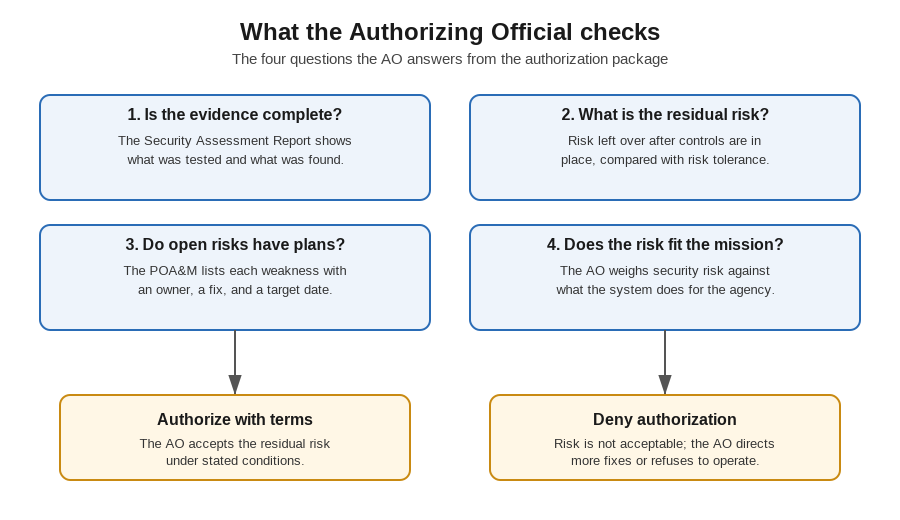
The AO reads the package for four things. Each one maps to part of the authorization package the System Owner assembles.
1. Assessment evidence is complete. The Security Assessment Report (SAR) shows what the assessor tested and what the assessor found NIST SP 800-37 Rev 2. Assessments must be done by qualified assessors with the required level of independence NIST SP 800-37 Rev 2. Independence is what makes the findings credible to the AO.
2. The plan matches the real system. The System Security Plan (SSP) describes the controls in place. The AO checks that the controls the SSP claims are the controls the assessor tested. A claim with no test behind it is just a promise. Gaps between the plan and the test results raise the risk the AO sees.
3. Every open weakness has a plan with a date. The Plan of Action and Milestones (POA&M) tracks each open weakness with its fix and target date NIST SP 800-37 Rev 2. The AO reviews the SAR and the POA&M and decides if more work is needed NIST SP 800-37 Rev 2. Nothing important should drift without an owner and a date.
4. The risk fits the mission. The AO weighs security risk against what the system does for the agency NIST SP 800-37 Rev 2. The decision may grant or deny an Authorization to Operate. It can also grant authorization with terms and conditions the system owner must follow NIST SP 800-37 Rev 2.
How to present the package so the AO can decide
Follow this order when you assemble the package.
- Start with a plain executive summary. State the risk posture in one page.
- Link every claim to evidence. Each control claim should point to the test result that supports it.
- Show that fixes were retested. Assessment procedures in NIST SP 800-53A cover re-verification of controls after changes NIST SP 800-53A Rev 5.
- Name the conditions. State what limits the AO should attach, such as a review frequency under ongoing authorization NIST SP 800-37 Rev 2.
PolicyCortex generates SSP, SAR, and POA&M output from evidence that 33 collectors read from live Azure configuration. It re-verifies controls after remediation.
Next step
Want the package built from live evidence instead of pasted screenshots? See how PolicyCortex works
Sources
- NIST SP 800-37 Rev 2, Risk Management Framework for Information Systems and Organizations: A System Life Cycle Approach for Security and Privacy. https://doi.org/10.6028/NIST.SP.800-37r2
- NIST SP 800-53A Rev 5, Assessing Security and Privacy Controls in Information Systems and Organizations. https://csrc.nist.gov/publications/detail/sp/800-53A/rev-5/final