Latest / Story
What Does the Authorizing Official Need from Continuous Monitoring Reports?
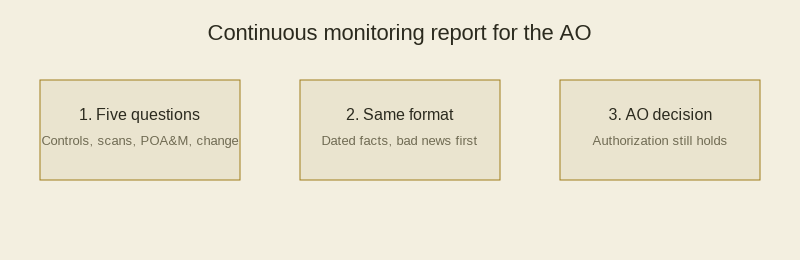
Your system holds an Authorization to Operate (ATO), but the work did not end at the decision. The Authorizing Official (AO) still needs proof that the system stays safe. That proof arrives in continuous monitoring reports.
The Risk Management Framework (RMF) is the process agencies use to authorize systems. NIST Special Publication 800-37 Revision 2 describes that process. The monitor step is the last step. It runs for the life of the system.
NIST Special Publication 800-137 describes continuous monitoring in detail. It calls for ongoing review of control status, risk, and change.
What goes in each report
Each report answers five questions. First, which controls changed since the last report? Second, what did the latest scans find? Third, which Plan of Action and Milestones (POA&M) entries opened, closed, or slipped? Fourth, what changed in the system? Fifth, did any incident occur?
Give the AO facts, not adjectives. A scan result with a date beats a line that says the system is safe. A POA&M entry with a due date beats a promise to fix it soon.
Include the raw counts. How many systems were scanned? How many flaws were found? How many were fixed? The AO reads the trend across reports, not one report alone.
How often to report
Your monitoring strategy sets the cadence. It names what to report and how often. The strategy is part of your authorization package. The AO approves it with the package. If the AO asks for a faster rhythm, that request wins.
What makes a report useful to the AO
The AO uses the report to decide if the authorization still holds. A clear report makes that decision easy. A vague report forces the AO to ask for more proof. Three habits keep reports useful. First, use the same format every time. Second, date every fact. Third, flag bad news at the top, not buried at the end.
Flagging bad news early builds trust. An AO who learns of a flaw from your report will keep the authorization. An AO who learns of it elsewhere may not.
What to do this week
Read your monitoring strategy. List the items it says to report. Check that your last report covered each one. Fix any item that is missing before the next report is due.
Sources
- NIST SP 800-37 Revision 2, National Institute of Standards and Technology.
- NIST SP 800-137, Information Security Continuous Monitoring, National Institute of Standards and Technology.
- NIST SP 800-53 Revision 5, National Institute of Standards and Technology.
- Original diagram by PolicyCortex.
Next step
Want monitoring evidence tied to each control? See how PolicyCortex collects it from live systems.