Latest / Story
What Does Acceptable Risk Actually Mean to an Authorizing Official?
Your package is ready, but one question still hangs over it. Will the official in charge accept the risk that remains? That decision is personal, formal, and based on your evidence.
The decision is about risk, not perfection
An authorizing official is called an AO for short. The AO is the senior official who decides if a system may operate. That decision is called an authorization. ATO means Authorization to Operate.
The AO does not require a perfect system. No system is perfect. The AO decides if the risk left after your controls is acceptable. Acceptable means the risk fits the mission need and the risk tolerance of the organization.
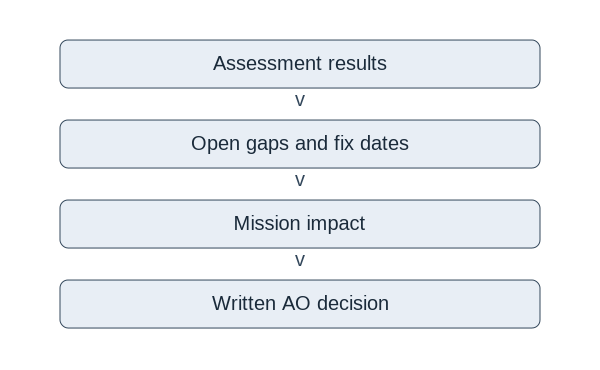
NIST SP 800-37 Revision 2 defines this step. NIST means National Institute of Standards and Technology. In that guide, the authorize step asks if remaining risk is acceptable (NIST SP 800-37 Revision 2). The AO makes that call after reviewing your assessment results and your POA&M. POA&M means Plan of Action and Milestones.
What the AO reads first
The AO reads the assessment results. Those results show which controls work and which do not. The AO reads the POA&M next. That plan shows how each open gap will close, and when.
The AO also weighs mission impact. A system that supports a critical mission may carry more risk than a nice to have tool. A system that holds sensitive data carries less room for risk. Context changes the answer, even with the same gaps.
The AO looks for honesty in your package. A package that hides a gap loses trust fast. A package that names each gap, with a fix date, builds trust. Trust is part of the decision, even though no form measures it.
Risk acceptance is written down, not assumed
When the AO accepts risk, that acceptance goes in writing. The authorization decision letter records the decision. It records any conditions tied to the decision. A condition might limit who may use the system. A condition might require a fix by a set date.
Read those conditions as part of the authorization. They are not footnotes. If you miss a condition date, the authorization can be revisited. Track each condition like a task, with an owner and a due date.
If the AO denies authorization, that is also written down. A denial is not a ban for life. It is a list of risks that must drop first. Work that list in order, starting with the highest risk item.
How to make acceptable risk easier to grant
Give the AO a short risk summary at the front of your package. List each open gap in plain words. State what could happen if that gap is hit. State what fix is planned and when it lands.
Do not bury the worst gap at the back. Put it near the front, with its fix plan beside it. An AO who finds a surprise late in review will doubt the rest of the package.
Show that monitoring will catch change. Continuous monitoring means watching controls after authorization, not just before it. A clear monitoring plan tells the AO that new risk will surface fast. That plan makes acceptance easier, because acceptance is not blind.
A plain test before you submit
Ask one question about each open gap. Would a stranger trust this system with this gap open? If the answer is no, fix the gap or shrink it before you submit. If the answer is yes, write down why, in one short paragraph.
That paragraph is your risk case. Keep it factual. Name the control, the gap, the impact, and the fix date. The AO can then agree or disagree with a clear case, not a guess.
Next step
PolicyCortex collects evidence from live Azure configuration using 33 collectors. The collectors read conditional access, diagnostic settings, Defender posture, backup, and firewall. The evidence is evaluated against NIST 800-53 and NIST 800-171. It supports re-verification after remediation. It generates SSP, SAR, and POA&M output from collected evidence. SAR means Security Assessment Report. SSP means System Security Plan. PolicyCortex is strongest in commercial Azure, and AWS is covered. Start at https://policycortex.com.
Sources
- NIST SP 800-37 Revision 2, Risk Management Framework for Information Systems and Organizations: A System Life Cycle Approach for Security and Privacy, National Institute of Standards and Technology. https://doi.org/10.6028/NIST.SP.800-37r2
- NIST SP 800-53 Revision 5, Security and Privacy Controls for Information Systems and Organizations, National Institute of Standards and Technology. https://doi.org/10.6028/NIST.SP.800-53r5