Latest / Story
Supply Chain Events Belong in ATO Continuous Monitoring
ATO is Authorization to Operate. Continuous monitoring keeps that decision honest between assessments. Most monitoring watches vulnerabilities. UpdraftCentral shows it must also watch the supply chain.
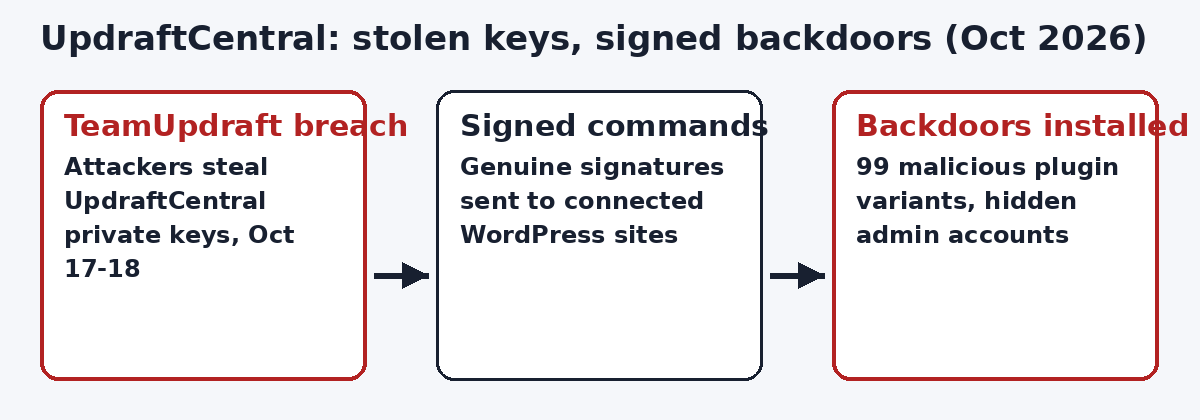
Over the weekend of October 17 and 18, 2026, attackers broke into TeamUpdraft's website. They stole the private keys behind UpdraftCentral, the remote management service for UpdraftPlus. They sent commands to connected WordPress sites and installed backdoor plugins with real signatures.
Security firm Nethemba found the campaign on its own servers. Security firm Patchstack counted 99 malicious plugin names installed between 15:32 UTC on October 18 and 09:23 UTC on October 19. Patchstack rates the impact at 9.8 on the Common Vulnerability Scoring System (CVSS) scale.
Why this is a monitoring event
NIST SP 800-53 control SI-4 asks agencies to monitor for attacks and indicators. Control SR-2 asks for supply chain risk assessment. A vendor key compromise that pushes code to your systems is both.
No CVE exists for this. No scanner will flag it. The detection comes from vendor disclosures and security researchers, not from your vulnerability feed.
Your monitoring plan should name supply chain sources: vendor security advisories, researcher publications, and the security press. The UpdraftCentral story reached all three within a day.
The monitoring record
For each vendor that holds access to an authorized system, the monitoring record should show the vendor, the access channel, and the last review date.
For this event, the record is specific. Which systems held a live UpdraftCentral key. Whether the compromise check ran: unknown plugins, unknown accounts, unknown cookies. Whether the remediation completed: the update, the rotation, and the manual deletion of keys created between 12:07 and 21:00 UTC on October 18.
The authorization boundary question
Federal systems include public websites. Those websites run on vendor software with vendor-held channels. The authorization package should name those channels as part of the boundary.
An assessor reviewing continuous monitoring evidence wants to see that supply chain events get the same treatment as vulnerabilities: detected, assessed, acted on, recorded.
What to do this week
Add vendor security advisories to your monitoring sources if they are not there. For this event, run the compromise check and record the result.
Then list the vendors that hold signing or management access over your systems. That list is now part of your monitoring scope.
Sources
- Security incident disclosure, TeamUpdraft, October 19, 2026. Vendor's primary incident statement.
- "Stolen UpdraftCentral Keys Are Backdooring WordPress Sites," Patchstack, October 19, 2026. https://patchstack.com/articles/updraftcentral-key-compromise-wordpress-backdoors/
- Campaign analysis, Nethemba, October 19, 2026. First detailed researcher analysis of the campaign.
- NIST SP 800-53 Revision 5, Security and Privacy Controls. https://doi.org/10.6028/NIST.SP.800-53r5
- Original diagram by PolicyCortex.
Next step
Want monitoring evidence that refreshes itself from the live system? See how PolicyCortex collects it on Azure.