Latest / Story
Pillow 13.0.0 and the Upload Boundary Your ATO Must Inventory
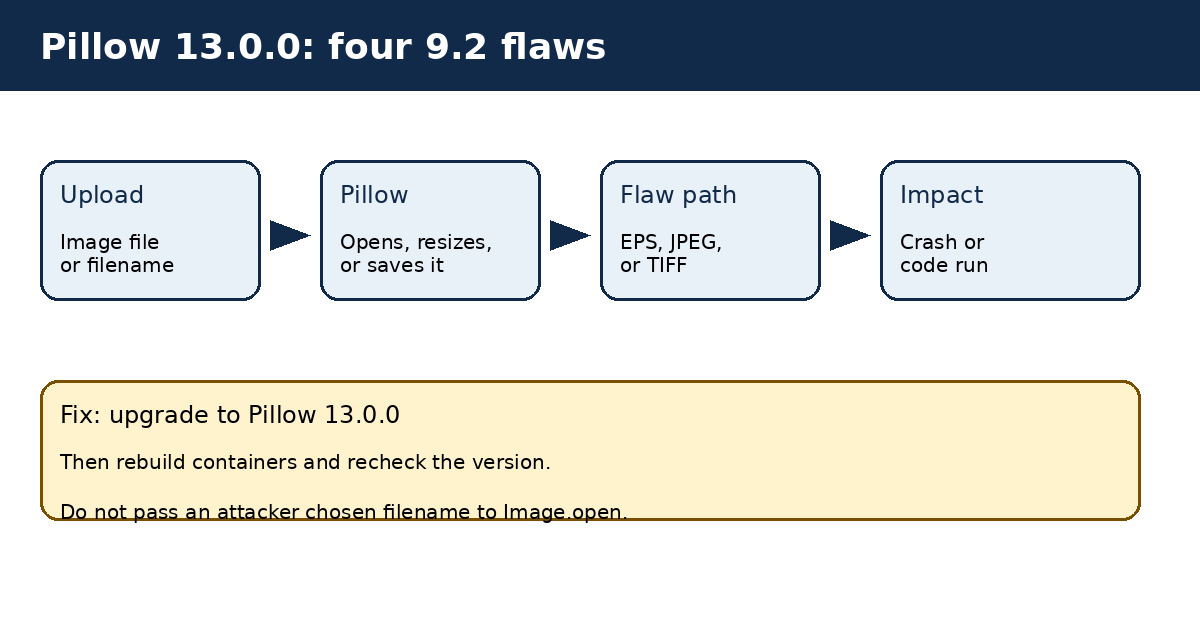
An Authorization to Operate (ATO) draws a boundary. Everything inside that boundary must be known. Pillow 13.0.0 shows why libraries belong inside it.
Pillow is a Python imaging library. It handles uploads, avatars, thumbnails, and document images. Pillow 13.0.0 arrived October 16, 2026. It fixes four flaws scored 9.2.
The four flaws
Common Vulnerabilities and Exposures (CVE) is the public record system. The Common Vulnerability Scoring System (CVSS) rates severity from 0 to 10.
- CVE-2026-112900: EPS filename injection into Ghostscript.
- CVE-2026-112398: FlashPix JPEG heap overflow on a normal open.
- CVE-2026-112403: Lossless JPEG heap overflow on draft or thumbnail.
- CVE-2026-112393: TIFF save heap overflow to memory.
Each flaw reaches a server through ordinary image handling. Upload endpoints are the realistic path. A file name, a thumbnail, or a re-encoded image can trigger one.
What belongs in the boundary file
List every upload service in the boundary. Record the Pillow version in each one. Include containers and bundled copies. Note which services run Ghostscript. Note which services run the olefile package.
Then record the upgrade to Pillow 13.0.0 per service. Test first, because version 13.0.0 drops Python 3.10. Rebuild container images. Recheck the version after deploy. Keep the recheck with the boundary file.
Also record the interim controls you used. Removing Ghostscript from hosts that do not need it counts. Renaming uploads to a safe name counts. Those controls show the boundary was managed, not just patched.
No wild exploitation is reported in the advisories checked. None of the four IDs is in the CISA Known Exploited Vulnerabilities catalog as checked October 25, 2026. Do not wait for a listing to act.
Sources
- Pillow 13.0.0 release notes, October 16, 2026.
- CVE-2026-112900 record, CVE Program.
- CVE-2026-112398 record, CVE Program.
- CVE-2026-112403 record, CVE Program.
- CVE-2026-112393 record, CVE Program.
- Original diagram by PolicyCortex.
Next step
Want boundary and version evidence linked to each system? See how PolicyCortex collects it from live systems.