Latest / Story
Edge Appliances Inside the Authorization Boundary: The October KEV Batch
An Authorization to Operate (ATO) rests on a drawn boundary. Everything inside that line needs an owner, a patch state, and monitoring. The October batch from the Cybersecurity and Infrastructure Security Agency (CISA) tests all three.
On October 14, 2026, CISA added four flaws to the Known Exploited Vulnerabilities (KEV) catalog. Reporting gives Federal Civilian Executive Branch agencies a due date of October 17, 2026. The flaws target systems that usually sit right on the boundary line.
Which systems sit on the line
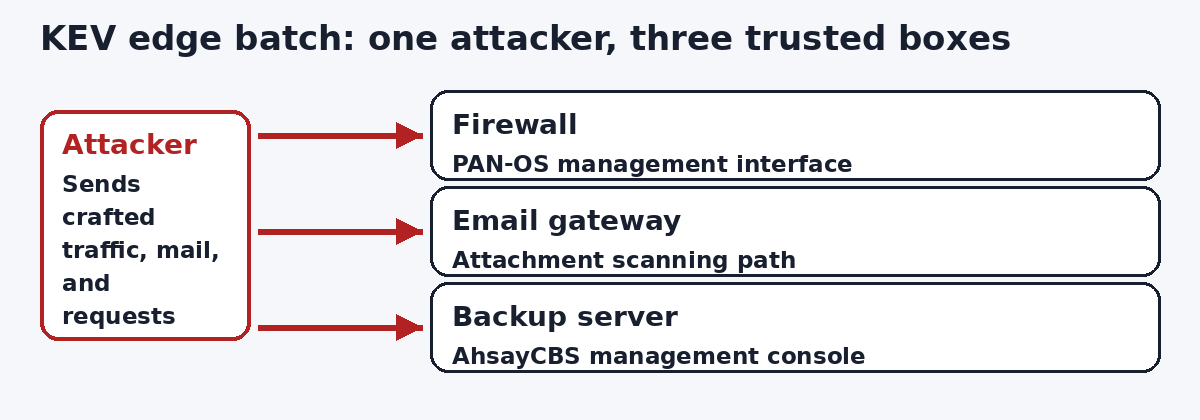
CVE-2026-0322 affects the PAN-OS management interface on Palo Alto Networks firewalls. An authenticated attacker with network reach can run code as root. The Common Vulnerability Scoring System (CVSS) score is 8.6.
CVE-2026-76519 affects Cisco Secure Email Gateway, scoring 9.8. A crafted attachment can write files and run commands as root. No login is needed for that attack.
CVE-2026-105133 and CVE-2026-105134 affect Ahsay AhsayCBS backup servers. Attackers chain the authentication flaw into the command injection flaw. The pair ends in SYSTEM level access on the server.
Why boundary placement changes the answer
A firewall on the boundary is not support equipment. It enforces the boundary for everything behind it. If an attacker owns that device, the boundary statement stops being true. Your package should say so before an assessor asks.
The same logic covers the mail gateway. It stands where outside mail becomes inside mail. The backup server is different, but just as central. It holds recovery copies and sits inside most boundaries by design.
Continuous monitoring fails when these systems report late. Many monitoring plans track servers and user devices closely. Appliances report through vendor consoles that nobody exports. That gap leaves the riskiest systems with the weakest evidence.
What monitoring evidence should show
For each appliance, record four facts in one place. Record the product and current build number. Record the fixed build from the vendor advisory. Record the date your team applied the fix. Record the compromise check and its result.
PolicyCortex does not patch these appliances. The vendor fix belongs to your team or your service provider. The evidence work is showing the fix happened, on time, inside the boundary.
What to do this week
Pull your boundary diagram and your appliance list together. Mark each firewall, mail gateway, and backup server on both. Patch any listed system still on a weak build. File the build record where your monitoring evidence already lives.
Sources
- CISA alert, CISA Adds Four Known Exploited Vulnerabilities to Catalog, October 14, 2026. https://www.cisa.gov/news-events/alerts/2026/10/14/cisa-adds-four-known-exploited-vulnerabilities-catalog
- CVE-2026-0322 record, CVE Program. Palo Alto Networks advisory at https://security.paloaltonetworks.com/CVE-2026-0322
- CVE-2026-76519 record, CVE Program. Cisco advisory cisco-sa-esa-afw-zqYJkjxp.
- CVE-2026-105133 and CVE-2026-105134 records, CVE Program.
- Original diagram by PolicyCortex.
Next step
Want boundary appliance patch records kept current without manual chasing? See how PolicyCortex collects that evidence from the live tenant.