Latest / Story
HPE ArubaOS 10.0 Flaws Belong in Your ATO Boundary, Not Beside It
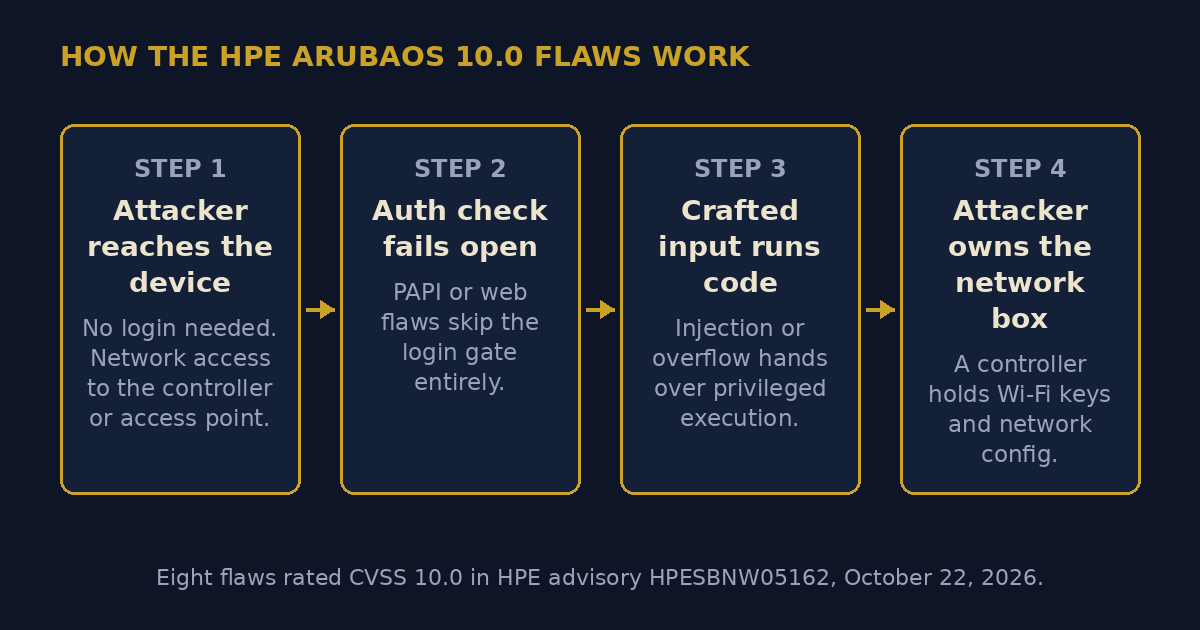
An authorization boundary is only as strong as its weakest listed system. HPE just showed how weak an unlisted wireless controller can be.
On October 22, 2026, HPE Networking published advisory HPESBNW05162. It fixes 72 flaws in ArubaOS 8 and 10. HPE rates eight at CVSS 3.1 10.0. Seven resolve to HPE records. One ID needs a note. Each needs network access only, no login, and no user action.
The eight listed flaws
Common Vulnerabilities and Exposures (CVE) is the public record system. The Common Vulnerability Scoring System (CVSS) rates severity from 0 to 10.
- CVE-2026-79844: AOS-10 authentication bypass to command execution.
- CVE-2026-79845: AOS-10 PAPI protocol authentication bypass to admin access. HPE lists it at 10.0. Its public CVE record names another product, so this article links it to the HPE advisory instead.
- CVE-2026-79847 and CVE-2026-79851: AOS-10 buffer overflows to remote code execution.
- CVE-2026-79846: AOS-8 command injection.
- CVE-2026-79848 and CVE-2026-79849: AOS-8 SQL injections to command execution.
- CVE-2026-79850: AOS-8 authentication bypass to root commands.
Fixed builds are AOS-10 10.8.1.2, 10.7.2.7, and 10.4.1.14, and AOS-8 8.13.3.1 and 8.10.0.24.
One ID needs care
HPE lists CVE-2026-79845 at 10.0 for the PAPI flaw. The public CVE record for that ID names a different product. It scores 7.3, not 10.0. Count seven verified 10.0 IDs until the record is fixed.
Why the boundary matters
Continuous monitoring watches what the boundary names. A controller outside the boundary gets no scan schedule. It gets no patch clock. It gets no log review.
That is the real risk here. A compromised controller sits inside the network. It holds Wi-Fi keys and client config. It can watch traffic that crosses it.
Three checks close the gap. First, confirm every Aruba controller, gateway, and access point is inside the boundary. Second, record the build on each device against the fixed list above. Third, add the re-scan result to the monitoring record once upgraded.
HPE reported on October 22, 2026 that it knew of no public exploit code. It also knew of no exploitation in the wild. No eight ID is in the CISA Known Exploited Vulnerabilities catalog as checked on October 25, 2026. Treat that as a window, not a verdict.
Sources
- HPE Networking security advisory HPESBNW05162, Multiple Vulnerabilities in HPE Networking Wireless Operating Systems (AOS-10 and AOS-8), October 22, 2026.
- CVE-2026-79844 record, CVE Program.
- The PAPI flaw listed as CVE-2026-79845 is sourced to the HPE advisory above. Its public CVE record currently names another product.
- CVE-2026-79846 record, CVE Program.
- CVE-2026-79847 record, CVE Program.
- CVE-2026-79848 record, CVE Program.
- CVE-2026-79849 record, CVE Program.
- CVE-2026-79850 record, CVE Program.
- CVE-2026-79851 record, CVE Program.
- Original diagram by PolicyCortex.
Next step
Want boundary and monitoring evidence linked without chasing spreadsheets? See how PolicyCortex collects it from live systems.