Latest / Story
How Do I Schedule the RMF Steps So the Assessment Does Not Slip?
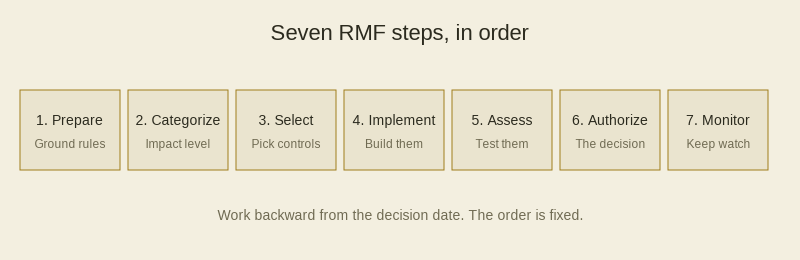
Your authorization decision date is fixed, but your assessment keeps sliding. The date does not move. The work must fit inside it. The Risk Management Framework (RMF) gives you seven steps. RMF means Risk Management Framework. A schedule that respects each step keeps the date.
The seven steps in order
NIST SP 800-37 Revision 2 sets out the RMF. NIST is the National Institute of Standards and Technology. SP means Special Publication. The steps are Prepare, Categorize, Select, Implement, Assess, Authorize, and Monitor. Each step has tasks. Each task has an owner and a due date.
Prepare sets the ground rules. Categorize sets the impact level for the system. Select picks the controls from NIST SP 800-53 Revision 5. Implement puts the controls in place. Assess tests them. Authorize is the decision. Monitor keeps watch after the decision.
You cannot assess a control that is not built. You cannot authorize a system that is not assessed. The order is fixed. The schedule must follow it.
Work backward from the decision date
Start at the decision date and walk back. The authorizing official needs the package before the decision meeting. The assessment must finish before the package is built. Fixes must finish before the assessment ends. Build time must come before the assessment starts. The dates add up fast.
Where schedules slip
Three slips cause many delays. First, the system description changes late. A new connection or a new service restarts the categorization work. Second, controls fail the assessment. Each failed control needs a fix and a retest. Third, evidence arrives late. The assessor waits while the team hunts for logs.
Freeze the system description early. Pick a date after which no new connection enters the package without a review. Test controls yourself before the assessor arrives. Collect evidence as you build, not after.
Build the schedule
Put every RMF task on one page. Give each task an owner and a due date. Mark the tasks that block other tasks. The assessment cannot start until implementation ends. The decision cannot happen until the assessment ends. Review the page each week with the system owner.
Add buffer after the assessment. Failed controls need fix time. A retest needs assessor time. A schedule with no buffer slips on the first failed control.
What to do this week
Write down your decision date. Walk back through the seven steps. Assign an owner to each step. Freeze the system description. Then test one control yourself before the assessor does.
Sources
- NIST SP 800-37 Revision 2, National Institute of Standards and Technology.
- NIST SP 800-53 Revision 5, National Institute of Standards and Technology.
- Original diagram by PolicyCortex.
Next step
Want your authorization evidence gathered from live systems, not by hand? See how PolicyCortex collects it automatically.