Latest / Story
How Do I Document Controls I Inherit from My Cloud Provider?
Your cloud provider runs part of your system, but you still own the authorization. An authorizing official will ask what the provider covers and what you cover. If you cannot answer that question, your package stalls.
ATO means Authorization to Operate. RMF means Risk Management Framework. The RMF authorize step is where an authorizing official decides if risk is acceptable. AO means Authorizing Official. CSP means cloud service provider. NIST SP 800-37 Revision 2 describes the RMF steps, including authorize.
Start with the provider control list
Ask your provider for its control list. The list should name each control the provider claims. It should also name the evidence behind each claim. If the provider cannot share a control list, you cannot claim inheritance for those controls.
Read each control claim with care. Some claims cover the full control. Some claims cover only part of it. A claim that says the provider encrypts stored data is partial. You still must prove who holds the keys and who can read the data.
Sort every control into three groups
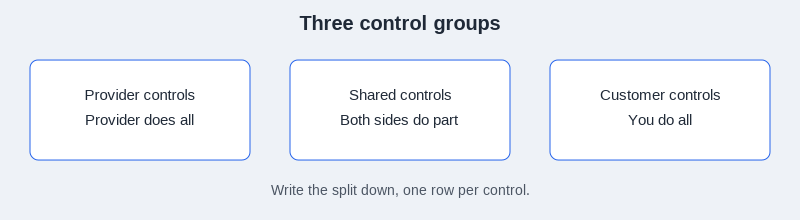
Group one is provider controls. The provider does all the work. You only keep the provider evidence on file. Group two is shared controls. Both sides do part of the work. Group three is customer controls. You do all the work.
Write the split down in a table. Each row needs four facts. First, the control name. Second, the group it sits in. Third, what the provider does. Fourth, what you do. One row per control. No row should say that both sides do everything.
Write the split into your System Security Plan
SSP means System Security Plan. Your SSP must show the split for each inherited control. Do not write that the provider handles security in general. Name the control, name the provider part, and name your part.
Add the provider evidence behind each inherited control. That evidence may be an authorization letter. It may be a control summary from the provider. It may be a recent assessment report. File it where your assessor can open it fast.
Keep watching after the authorization
Inheritance is not a one time task. Providers change services and change controls. A provider change can break your inheritance claim. Ask the provider how it tells customers about changes. Put that notice in your continuous monitoring plan.
Review inherited controls at least once a year. Check that the provider evidence is still current. Check that your part of each shared control still works. Test your part yourself. An assessor will test your part, not the provider part.
What to do when a control has no provider evidence
Do not claim inheritance without evidence. Mark the control as a customer control instead. Do the work yourself, and collect your own evidence. A control with weak provider evidence is worse than a control you own outright. Weak evidence fails at assessment time, when fixes cost the most time.
Sources
- NIST SP 800-37 Revision 2.
- NIST SP 800-53 Revision 5.
- NIST SP 800-18 Revision 2.
- Original diagram by PolicyCortex.
Next step
Want evidence tied to each control from live systems? See how PolicyCortex collects it.