Latest / Story
The Phone System Is Part of the Authorization Boundary
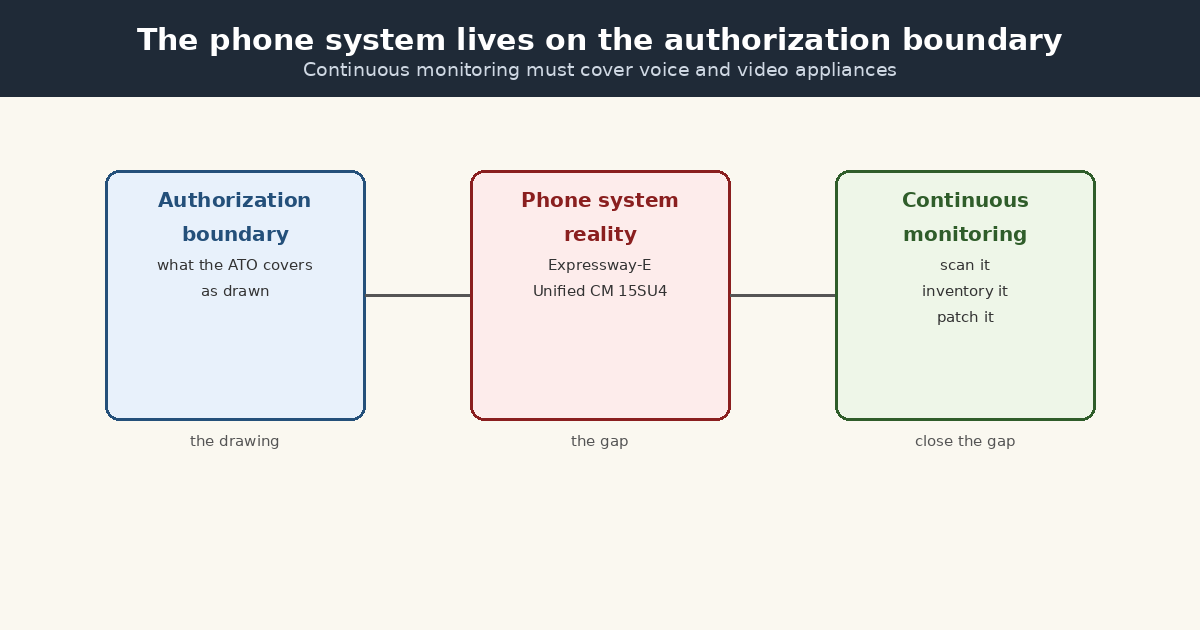
An authorization boundary is a drawing. Reality is a phone system nobody scans. Cisco's October 21, 2026 hardening releases show why the two must match.
The worst flaw needs no login. It gives a remote attacker root on clustered Cisco Expressway.
What Cisco fixed
The record is CVE-2026-76466. Common Vulnerabilities and Exposures (CVE) is the record system.
The flaw is in the database service of clustered Expressway-C and Expressway-E. An unauthenticated remote attacker with network access can run OS (operating system) commands as root. Cisco scores it 9.8. The fix is X15.5.20. No workaround exists.
A second advisory hardens Unified Communications products. It carries eight CVEs, including CVE-2026-76473 and CVE-2026-76474, both scored 9.8. The fix is release 15SU5.
A third advisory hardens Snort 3. It carries four grouped CVEs topped by CVE-2026-20043, scored 9.0.
Cisco knows of no malicious use for any of these as of October 21, 2026.
Why the boundary drawing matters
The authorization package describes what is in scope. Voice and video appliances are often left out. They belong to the phone team, not the security team.
That gap is exactly what continuous monitoring should close. Scans should cover every appliance inside the boundary drawing. New flaws should map to the inventory the same week they publish.
When a 9.8 lands on a box outside the scan scope, the monitoring program has a hole. The fix is to widen the scope, not to argue the box is special.
The evidence to keep
Keep a current inventory of every voice and video appliance with its build number. Keep dated scan results that include those appliances. Keep patch tickets showing before and after versions.
When the next advisory drops, the question is simple. Which of our boxes are affected, and what proves we fixed them.
PolicyCortex does not patch Cisco products. Your team applies vendor fixes. PolicyCortex helps keep the monitoring evidence current.
What to do this week
Check whether Expressway and Unified CM sit inside your boundary drawing. Add any missing appliance to the scan scope. Patch to X15.5.20 and 15SU5 and record the proof.
Sources
- CVE-2026-76466 record, CVE Program.
- Cisco Security Advisory cisco-sa-vcs-static-cred-hr7EWZ8t, Cisco Expressway Series Remote Code Execution Vulnerability, October 21, 2026. https://sec.cloudapps.cisco.com/security/center/content/CiscoSecurityAdvisory/cisco-sa-vcs-static-cred-hr7EWZ8t
- Cisco Security Advisory cisco-sa-voice-hardening-twgbH9e3, Cisco Unified Communications Products Security Hardening Release: October 2026, October 21, 2026. https://sec.cloudapps.cisco.com/security/center/content/CiscoSecurityAdvisory/cisco-sa-voice-hardening-twgbH9e3
- Original diagram by PolicyCortex.
Next step
Want monitoring evidence that stays current with your boundary? See how PolicyCortex collects it from live systems.