Latest / Story
Brotli KEV Flaw: What It Means for an ATO Package
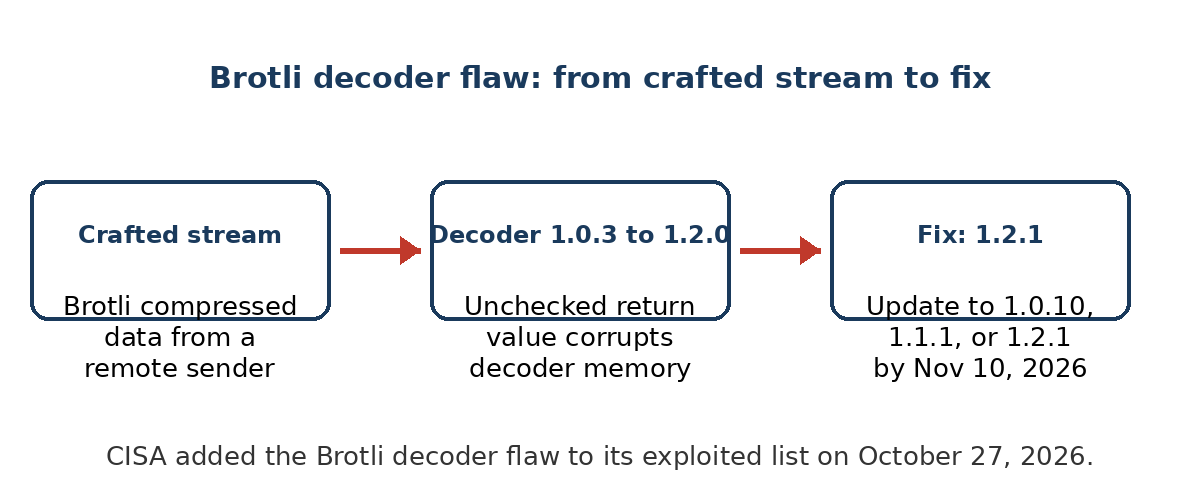
An Authority to Operate (ATO) is a decision based on evidence. A newly listed flaw is new evidence, and it must reach the package.
The listing
The Cybersecurity and Infrastructure Security Agency (CISA) added a flaw on October 27, 2026. The catalog is Known Exploited Vulnerabilities (KEV). CISA lists a flaw there only when exploitation is known. The record is CVE-2026-111497. Common Vulnerabilities and Exposures (CVE) is the record system for public flaws. Federal civilian agencies must act by November 10, 2026. An authorizing official will expect action on that same timeline.
The flaw in plain words
Brotli is a compression format for web data. A decoder reads compressed data and turns it back into plain data. The flaw sits in that decoder code. A remote attacker needs no account and no login. A crafted compressed stream can corrupt decoder memory. It can leak memory or crash the service. It can also run attacker code in some cases. Versions 1.0.3 through 1.2.0 are affected on all platforms.
What belongs in the package
First, the flaw entry itself, with the listing date of October 27, 2026. Second, the component inventory, with each product that bundles Brotli. Brotli is a library, not a product you install on its own. Many tools bundle it inside their own code. Third, the version record for each component. Line 1.0 is fixed at 1.0.10. Line 1.1 is fixed at 1.1.1. Line 1.2 is fixed at 1.2.1. Fourth, the patch date and the scan result for each component. A component with no version on file is still an open item. It does not disappear because it was hard to find.
Why the authorizer cares about a library
An authorizer signs off on risk for a whole system. A library flaw crosses component lines. It can sit in a web tier, a runtime, and a tool at once. A package that names only one patched product understates the risk. A package that lists every bundled copy shows the boundary is understood. That is the difference between a patch note and an authorization record.
PolicyCortex does not patch Brotli or any bundled product. Vendors ship those fixes. PolicyCortex helps teams link proof to requirements.
Sources
- CVE-2026-111497 record, CVE Program. Affected versions 1.0.3 through 1.2.0. Fixed versions 1.0.10, 1.1.1, and 1.2.1.
- National Vulnerability Database (NVD) record for CVE-2026-111497.
- CISA Known Exploited Vulnerabilities catalog, catalog version 2026.10.27. Entry for CVE-2026-111497, added October 27, 2026, due November 10, 2026. https://www.cisa.gov/sites/default/files/feeds/known_exploited_vulnerabilities.json
- Original diagram by PolicyCortex.
Next step
Add the Brotli flaw to your authorization package with the full component inventory. File the patch proof for each component.